
Safety and Climate
Why focus on climate as the foundation for safety?
Everyday actions of the adults in a school are critical to creating a positive climate. The adults in a school have the power to shape it into a positive one. Leaders have the responsibility to oversee the climate internally by developing an infrastructure that grows and maintains a positive culture with intentionality.

A positive climate increases student and staff connectedness. It enhances student academic success while decreasing the chances of suffering from threats or hazards. It is not a panacea, but studies have found that for students attending a school with a positive climate, there is a decrease in absences, suspensions, substance use, and bullying. In addition to reducing risky behavior, a positive climate is related to academic achievement, motivation to learn, and psychological well-being.
The National Center on School Climate defines climate as
Students cannot optimally learn if they feel unsafe in their school environment.
- the quality and character of school life
- based on patterns of students’, parents’, and school personnel’s experience of school life
- reflects norms, goals, values, relationships, teaching and learning practices, and organizational structures
The climate of a school consists of many connecting parts and can range from positive and supportive to negative and toxic.
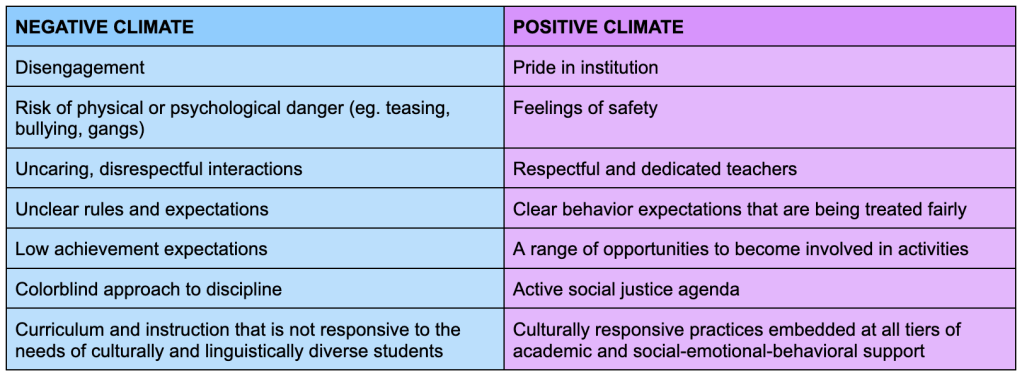
This chart identifies some of the differences you can see in a positive climate versus a negative one.
A positive climate is a product of a school’s attention to
- fostering safety
- promoting feelings of connectedness
- promoting a supportive academic, disciplinary, and physical environment
- encouraging respectful and trusting relationships throughout the school community
To hear Principal Hortensia Cota talk about school safety protocols, click play below.
To hear Principal Jen McBeth talk about safety from within, click play below.
What’s Next: To share information with staff and other stakeholders using the handout or PowerPoint. For more information, check out our additional resources. Now, move on to learn about Youth as Resources.
 schoolsafetyinitiatives.org