
Selecting Team Members
High-performing teams tap into the unique talents and skills of their individual memberships and value the diversity that those individuals represent. To be effective, the SLT must have the “right” people who have the skills, background, and commitment to guide the prevention activities at a school site.
The SLT needs to have members with expertise in school organization, safety, climate, and behavior. Expertise in these areas can be found in a mental health professional, nurse, school counselor, health educator, or teacher.
Here are some questions that are helpful to ask about identifying members. Remember, members can include school and district management, teachers and other school personnel, community stakeholders, students, families, civil society, and religious organizations.
Questions to Ask About Potential SLT Members:
- What levels of representation are needed – school, district, community, or county?
- What knowledge and skills are needed?
- Who is already involved on similar teams or with similar initiatives?
- What do you need team members to do?
- What does their support need to look like?
- Is there an overlap in tasks or roles? Can they be streamlined or integrated?
But you cannot just put people together into a team and expect them to work together well. There are many other things to consider.
Team members should:
- Represent each part of the school. For example, all grades should be represented.
- Are influential with teachers and students.
- Have credibility in the school.
- Work well with others – strong interpersonal skills.
- Are willing and able to give extra time to make prevention efforts a success.
- Have planning and communication skills.
- An understanding of and commitment to the team goals.
- An understanding and acceptance of their team roles, functions, and responsibilities.
- A balance of assertiveness (ask the difficult questions) and respect for the team’s process (respecting diverse opinions).
These serve as a type of summary of the characteristics. It is rare that any one person will have all the characteristics you need. The team needs to have a balance of skills. Here is an example of how you might think about these characteristics. It is rare that any one person will have all the characteristics you need. Think about the staff at this school. Who might be good SLT members? What could youth contribute?

Use the chart below to examine the skills each of the team members brings to the table. Does this team as a whole have all the skills and background necessary to complete this task?
SLT Team Membership Form – Example
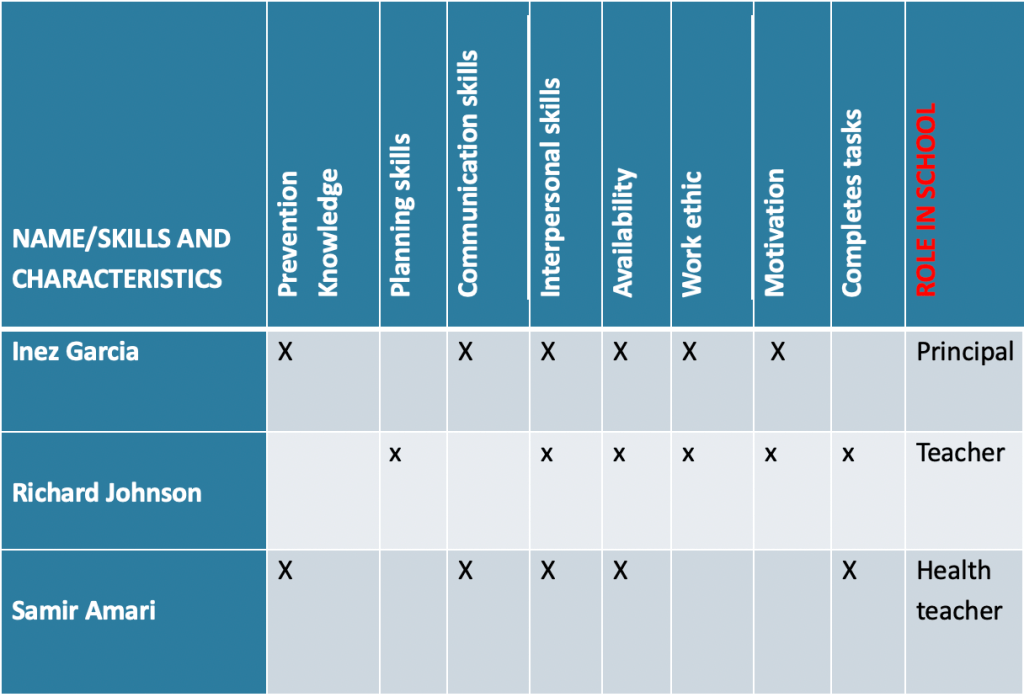
Click here for a blank Team Membership planning form to download.
Recruitment Message for Team Membership
Since we would want people with specific skills and characteristics on the team, avoid asking for volunteers. Recruit members who meet the qualifications and characteristics. To attract potential members, do some preliminary work to anticipate the concerns of potential members and to build a message to persuade them to join this important endeavor.
This would include some of the following:
- The mission of the team.
- Skills that they can bring to the team.
- Expectations for attendance – e.g., how much time is required, the number of meetings per month, how many hours per month per meeting.
- Roles and responsibilities – that is, description of these and why they are uniquely qualified to be on the team and their potential contributions to the work.
- How they can participate – e.g., they will be given time off or have their classes covered, etc.
- Potential compensation or incentives for their participation—e.g., actual reimbursement; eligibility for a bonus; or some other incentive
To convince them to participate, we need to persuade them of the importance of participating in the SLT to them, to the school, and to the students.

What’s Next: Once you have the team members, you need to identify a leader for the team.
Part 1 – For Leaders
- Team Mission and Goals
- Selecting Team Members
- Team Leadership
- Team Roles
- Team Development Framework
 schoolsafetyinitiatives.org