No matter how perfectly everyone on a team gets along, or how skilled they are at group processes and team skills, every team will go through steps as it develops into maturity.
Understanding these phases and helping teams move through them is essential to making teams fully functional.
It is important that a team does not avoid the more difficult stages of development. The model documents the five stages of team development and highlights the role leaders and team members can plan in helping the team move through those stages to be more productive.
Click here for the Stages of Team Development form. [insert]
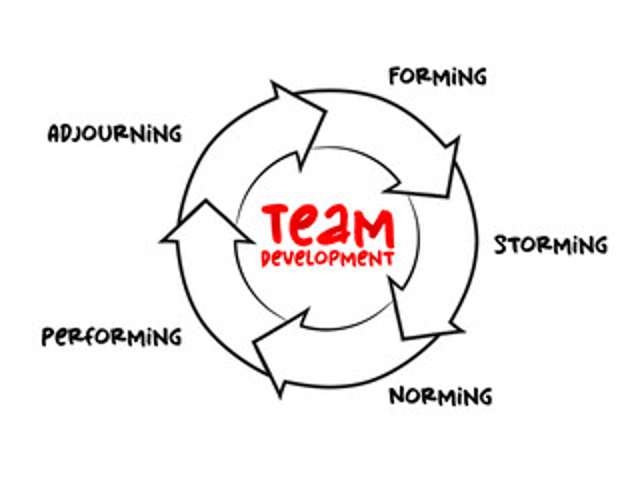
Forming or Nominal Community
The initial phase of any group involves forming, and that is setting up the objectives, goals, and structures for the team.
The focus in this phase should be understanding the team’s goals, and individual team members’ roles.
For team members, there is often a feeling of uncertainty about the team, its goals, and the role they play on the team.
There may be initial discomfort and worry about acceptance by other team members. The leader is crucial in clarifying the role of the team and team members in this phase.
Storming or Chaos
The next phase is storming, and here the focus is on team organization and strengthening of team goals and roles.
This usually occurs after the team gets moving with some activity. Some of the characteristics include conflict among team members or between team members and the leaders. Some of the conflicts might arise from uneven or lack of participation or competition.
Other characteristics may be placing different levels of priority on group activities and moving toward group norms.
In this phase, the leader needs to be supportive, listen actively, manage conflict, and look to drive for consensus. Sometimes this means a leader needs to meet individually with team members or can deal with the issue/s in the whole group.
The leader must be comfortable with conflict. This phase is necessary for people to pass through to be a more effective team.
Norming or Emptying
The third phase norming is when the team becomes more effective. The norms are established for behavior and goals, and the team structure is in place.
The team characteristics of this phase include trust and respect that are established among team members.
The idea is “I may not agree with everything you say or stand for, but I respect you and we are able to work together for a goal we agree upon.” There is more support for the team leader, and the team becomes more cohesive.
The role of the leader in the norming phase is to recognize group and individual efforts, to provide learning opportunities and feedback, and to share the leadership responsibilities.
Performing or Fully Functioning Community
The next phase of group and team development is the performing stage in which the teams are most effective in accomplishing their goals.
There is direct two-way communication among team members, increased collaboration and cooperation, and shared responsibility. Team members are adaptable, and the team has frequent self-evaluations and celebrations of success.
In the performing stage, the role of the leader is to focus on the purpose of the team, build relationships, coach members, remove the barriers, and empower team members to meet team goals.
Adjourning or Transforming
Teams who have a short-lived purpose will need to adjourn when it is completed or transform into doing another task. For example, a team that has completed its task of reviewing a policy and making decisions about a new policy may either adjourn or transform into doing another task.
The planning the team and the team leader do initially in setting the team’s scope and goals are critical in knowing when it is time for the team to either adjourn or transform. Characteristics may include that there is recognition of the team and individual efforts, there may be sadness if the team ends, and uncertainty if the team reforms for new goals.
A period of significant change that may happen in some groups. Types of changes that may occur include losing or adding members, redefining a team’s primary mission, or a total break-up of the team. Any of these changes have a major impact on the team and will force members to address their fundamental expectations, goals, norms, and ground rules.
In many cases, teams will regress to one of the previous stages and then work their way back to achievement.

Part 1: Forming an Effective Leadership Action Team
- A. Why is Leadership Important?
- B. Team Development Framework
- C. Team Leadership
- D. Team Mission and Goals
Part 2: Team Membership, Recruitment, and Roles
Part 3: Team Functioning
- A. Team Norms
- B. Supporting Team Members
- C. Team Building
- D. Stages in Team Development
Part 4: Team Building
 schoolsafetyinitiatives.org